Amazing Singapore James Cook University at Sims Drive

Amazing Kallang MRT beside the Kallang River

Share

Friday, March 8, 2013

From Sleeping in the street to donating a kaikan

http://gosho-passages.blogspot.sg/

http://www.gakkaionline.net/Experiences/PubsGrandma.html

[Excerpted from the August, 2000, Living Buddhism, pp. 36-38]
Chieko Yamashita was married after WWII. Her husband failed in business and became obsessed with drinking and gambling.
Her family of four had no place to live, but were given shelter in the corner of a friend's kitchen. During the day, they would stay in a small park, with her infant child crawling around on the ground.
With help they were able to find a tiny one-room apartment; but they were still destitute.
To make dinner, she would go out with two ten-yen coins and buy sardines and spinach. She searched the streets of the outdoor market for dropped coins.
At one point, she had to leave her husband and children. The children were put into childcare. Overcome with anguish at the thought of this, she decided to gather her children and return to her husband. What followed were days of living in fear of physical abuse.
Ms. Yamashita joined the Soka Gakkai in 1965. At the time her husband was unemployed and she was supporting him by selling insurance door-to-door. Her husband also joined, but it was in name only. He would go to great lengths to keep his wife from practicing.
Each night he would beat her and demand that she quit the SGI. On one occasion he destroyed her altar with an ax, doused the wood with kerosene and set it on fire.  She ran out of the house barefoot, clutching the Gohonzon to her chest. She spent the night locked outdoors chanting daimoku until dawn.
Eventually her husband found work. But he was reckless with money and they continued to live in poverty.
Throughout this time, Mrs. Yamashita scrimped and saved with the dream of one day having a house. When she had saved four million yen, she showed her savings passbook to her husband. He snatched it away. When she located it two days later, her account had a balance of zero. He had lost it all at the race track.
A senior in faith told her that she must take ultimate responsibility for her happiness. She was told "Unless you change, you will not be able to accumulate good fortune."
When she heard this, she made up her mind not to give up. She said
"The Daishonin says, 'Buddhism is like the body, and society like the shadow. When the body bends, so does the shadow' (Writings of Nichiren Daishonin, p. 1039). I determined to stop swinging between joy and sorrow because of the chaos in my life and to stop complaining about what my husband was or wasn't doing. I decided since this was my karma, I would take responsibility for overcoming it. I realized it was not about anyone else; everything depended on my life condition. I gained a profound conviction in the principle of oneness of life and environment."
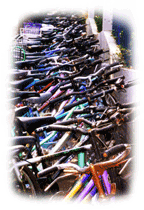
Mrs. Yamashita exerted herself wholeheartedly in Gakkai activities. In the process, she was unexpectedly approached about managing some land in front of the train station. In the seventh year of her practice (1972), she was able to open her bicycle parking lot. More than anything else, her attitude began to change. She came to have sympathy for her husband. She came to view her husband as a "good friend' for enabling her to deepen her faith.
She explains, 
"It's amazing. As soon as my resentment toward my husband turned into appreciation, he suddenly lost his infatuation with gambling. And he began to pray to the Gohonzon. For the first time we became a true married couple, able to talk openly and honestly about anything. Through all the negative and positive experiences, my husband taught me about faith. I have grown into a person who can feel incredible appreciation, knowing that I owe everything to the terrible hardship I experienced."  
In addition to transforming her state of life, Mrs. Yamashita has transformed her financial fortune and she was able to realize her longstanding dream of building a private community center.  Daisaku Ikeda gave the center the name "Yamashita Glory Community Center." When she received Mr. Ikeda's calligraphy of these words, she took the characters for community center to mean "Treasure House." 
Although she is the president of a company that operates a bicycle parking lot of approximately 4,000 yards, when asked what she does she says, "I'm just the bicycle lot grandma."

http://chantforabetterlife.wordpress.com/2011/03/12/happiness-in-singapore/#comment-566 
 

Saturday, March 2, 2013

Protecting the environment

by Shin Won-suk
Korea http://www.sgi.org/about-us/members-stories/my-small-step.html

Shin Won-sukMr. Shin Won-suk cleaning the polluted river
I have been practicing Nichiren Buddhism since 1973, and by engaging in SGI activities I have learned the importance of living a contributive life--to be concerned not only for myself but for others and for society as a whole. Taking to heart SGI President Ikeda's constant encouragement to become an asset to our local community and society, I began to think deeply about what I could do to contribute.
It occurred to me that there was no need to start with something big, but there must be something I can do using my skills and background as a landscape gardener. There is a river, the Taehwa, that runs through the city of Ulsan, where I live, which is heavily polluted. I decided to somehow help restore this river.
Throughout history, the Taehwa River has been considered a lifeline for the city's residents. However, Ulsan is one of the most industrialized cities of South Korea, and because of heavy pollution from industrial waste, the Taehwa came to be known as "the river of death."
developing bamboo fieldsDeveloping bamboo fields
I realized that in order to nurture a healthy environment, we must be prepared to actively protect it. Thinking of myself as "the protector of the Taehwa River," I began making time to care for the environment around the river, doing things such as developing bamboo fields, removing waste and pruning branches of trees along the river, inviting local residents and fellow SGI-Korea members to join in.
In 2008, I began serving as chair of a local ecological restoration group with over 700 registered volunteers. Once a week, I engage in volunteer work such as picking up trash from the river, cleaning up hiking trails and recycling waste materials. I also take part in educational activities to raise awareness about environmental protection in the local community such as giving lectures at universities.
Seven years have passed since I began to take action and, as a result of our efforts, the beauty of the Taehwa River has been restored. Fish are once again swimming in its waters, and herons now also make the river their home.
I hope to continue encouraging my fellow SGI-Korea members and local residents to become involved in these activities.
picking up trashVolunteer members picking up trash
The challenge of reviving the environment requires a lot of time and effort. We don't always see immediate results, and at times, I do get frustrated and weary. However, what has kept me going in my efforts to help restore the environment are the simple words of appreciation we get from local residents. Moreover, as I chant every night upon returning home from a day of volunteer work, I feel a deep sense of fulfillment, which in turn becomes a source of energy to continue my efforts. As Nichiren Daishonin states in his writings, "If one lights a fire for others, one will brighten one's own way."
In Buddhism, we uphold the principle of "oneness of self and environment," meaning that life and its environment are inseparable. It is deeply rewarding to know that the small step of deciding to do something positive, and my efforts to convey to others the spirit of coexisting with nature, have led to a revival of the environment and the lives of those around me. While it's easy to be overwhelmed by problems in our communities, each of us can do something to make a difference.
[Courtesy January 2013 SGI Quarterly]


8888.henry@gmail.com

Sunday, January 13, 2013

91 years old member still active in contributing for kosen rufu


http://www.sgi.org/about-us/members-stories/the-long-road-ahead.html

The Long Road Ahead

by Atsuma Ueda
Japan

Mr. UedaMr. Ueda (right) at a meeting with local business owners [©Seikyo Shimbun]
In 1954, when I was 33 years old, I opened a clothing store in Mihara city, Hiroshima Prefecture. Business thrived and I was eventually able to open three stores around Hiroshima.
However, the new stores didn't enjoy the same success, and six months later I was on the verge of bankruptcy. I felt I could no longer go on living. All this time, my wife, Teruko, had been encouraging me to begin practicing Nichiren Buddhism. Convinced that faith had nothing to do with business, I had shown little interest.
I was intrigued, however, by the Buddhist concept of "human revolution," that a change in the inner life of a person will create a change in their circumstances, and began to read up on it. I thought, "Well, it's true that transforming myself is the basis of everything."
I started practicing Buddhism and felt full of life. I realized that my problems weren't as bad as they seemed. Around the same time, my friends began to offer their support in taking care of matters if I went bankrupt. Surprised by my optimistic attitude, they instead began to help me pull my business back together. As a result, I was able to avoid going bankrupt and business began to look up. Later, my company merged with a supermarket chain, and I was appointed company director. I went on to serve as the chief of its West Japan headquarters.
In 1983, the year before I was to retire, I received a poem of encouragement from SGI President Daisaku Ikeda during one of his visits to Hiroshima. This had a profound impact on me. It was as if he was telling me, "Your true stage awaits you!" Approaching retirement, I had been feeling as if I had reached the end of the line. However, I realized, "Yes, I am only 60 years old! There's no reason I can't go on making an active contribution until I'm 100!"
I threw myself into voluntary advisory work which I had begun doing for corporations, helping people start up businesses as well as offering advice on post-retirement life to retirees. I also dedicated myself to listening to and supporting younger colleagues.
I tell retirees, "You're still an active part of society for 30, 40 years to come. All the experiences you've gained in your busy careers are your life's treasures."
Seeing the importance of revitalizing one's community, I helped launch a local revitalization committee in my hometown of Mihara. In 1996, when I was 75 years old, I became the first general director (and currently serve as the president) of a social welfare corporation that helps people with physical and mental disabilities join the workforce.
In January 2005, when I was approaching the age of 84, I was diagnosed with prostate cancer. This was a shock, but I told myself, "There is more work to be done. I'm still in the middle of helping revitalize my local community. I mustn't die yet." I underwent treatment, and when I was tested again in October that year, all counts were back to normal.
Often, young employees come to me with their problems, telling me they want to quit. I share with them my analogy of the cup, which represents one's capacity as a human being. I tell them that they have to expand their capacity from that small cup: first to a large bowl, then to a bucket, a barrel, a pond and eventually a lake. My Buddhist practice has taught me that this is the most significant undertaking of life.
I'm 91 years old now, and the older I become, the more my horizons expand. I still have a lot of unfinished "homework" to take care of--this is what keeps my life force strong. I have a long road ahead of me. I have decided that I must win in life, no matter what. This is what keeps me vigorous.
[Courtesy October 2012 SGI Quarterly]

8888.henry@gmail.com 

Wednesday, September 19, 2012

The Building That Looks Down on Airplanes

http://www.gakkaionline.net/Experiences/WorldBuilding.html

The Building That Looks Down on Airplanes
When you don't feel like doing gongyo or daimoku, get on the green train in Tokyo that circles downtown I. and look out for the "Sunshine Building" near K--- station. This was built by someone who did not skip gongyo and daimoku for 30 years.
Once there was man who was so completely down and out that he had made up his mind to commit suicide. He was in debt to his ears, his wife was blind, and his child had problems. But before he died, he wanted to have one last meal of his favorite dish — a vegetable stew called "oden." 
As he was walking around town in the evening shadows looking for a stew shop, he noticed a warm, gentle glow of lanterns coming from a place tucked in a corner. There were a number of people milling about. "Ah, a stew shop!" he delightedly mused. He walked briskly toward the light.
As he entered and made his way through the small crowd, he realized he had made a mistake. It was a lecture. When he asked a person nearby, he was told that the speaker was a Mr. Toda. 
After listening, the man demanded of Mr. Toda, "If this Nam Myoho-renge-kyo is so powerful, will my financial problems be resolved?! Will my wife see?! Will my child's problems be resolved?!" 
To this, Mr. Toda replied: "Don't be ridiculous! If all it did were petty things like that, I wouldn't be doing this! Your financial problems will be resolved! Your wife will be able to see! And your child's problems will be resolved! Not only that, you will become a wealthy man! You will build a building that even looks down on airplanes! Do morning and evening gongyo and chant daimoku every day." 
Not because the man believed any of it, but because he was moved by the powerful conviction Mr. Toda had, he began to practice. Although it was difficult at first, he faithfully followed President Toda's instructions. He did not skip gongyo. He did morning and evening gongyo and chanted one and a half hour of daimoku every day.
Sure enough, results began to happen. His financial problems were solved. His wife was no longer blind. His child no longer had such problems. The man even became vice president of a board in his company even though he was not well-educated like most of his peers. He became wealthy. His child became active in the youth division. Things exceeded his expectations.
At the mark of practicing 30 years, he was seen standing on the top of a building, mumbling through tears. The man was standing on the top of a skyscraper that he had built. "It all became true! This building even looks down on airplanes! After 30 years ... Thank you Sensei, thank you Soka Gakkai!"
It wasn't many years later that the man passed away in his 80's, leaving a legacy of consistent practice. But before he did, he often pointed to the skyscraper and said, "This shows the power of daimoku!  I am here to say it. So please, do morning and evening gongyo and chant daimoku."
So when you don't feel like doing gongyo or chanting daimoku, take a look at the "Sunshine Building." It's still there. 
[Here is a picture of the City of Ikebukuro (in Tokyo) and the Sunshine Building. It is very well known and was once the tallest building in Tokyo. It has everything in it: business offices, restaurants, a department store, even an aquarium and a planetarium. The Sunshine Building was built on the site where Suginamo Prison — where Mr. Makiguichi and Mr. Toda were imprisoned — once was.] 
 

Tuesday, April 17, 2012

Prayer

An email from Ms Sandra Liew:

Prayer

Mr. Kawai's guidance in faith, conveyed by Mr. Noro, based on President Ikeda's guidance.
We practice this faith not for mere exertion, that is, not for the sake of practice, but for change and progress and as quickly as possible.

Members may say, I'm doing many SGI activities, but so what? The real question is how much have I changed my life, my environment, and my livelihood? How much benefit have I received? There are many members who are doing lots of daimoku, but there is no change in their lives.

Something is wrong. Buddhism is not the Law of Cause and Effect in Action. It is the Law of cause and effect in ichinen (determined prayer). For example, faith is not "feeling refreshed" after prayers and activities. Faith exists for us to change our lives.

When we wish to travel somewhere, first we decide on the destination, then we plan on the action (route/ mode of transport) and then we travel and reach that destination. Faith is the same.
In faith, we must first have
1.    clear targets
2.    prayer
3.    action

It is important to pray strongly and then take action and we will see the results without fail. It is important to determine to change. That is to pray "I want to change", and then take necessary action.

It is absolutely no use to ask the Gohonzon, "What should I do?" There will be no answer. YOU must decide what you want to accomplish, not the Gohonzon. Once we decide / determine on some goal, there may seem no solution. But that is precisely why we pray.

If it were possible, we would not need the Gohonzon. If there is a way out, then there really is no need to chant. But we pray to change the impossible to possible. Do not engage in "what shall I do..." daimoku, that is, while chanting to think of strategies / look for options in your mind.

There is absolutely no need to think of methodology, because there is no way out! We should simply pray like this "I want to accomplish this. I will accomplish this."

If, while chanting, we think that our desires are unattainable / impossible, then that is the prayer that will be reflected onto the universe. And that is exactly the answer we will get back from the gohonzon... impossible/no solution.

We must pray with 100% confidence in the Gohonzon. I believe in the Gohonzon, my prayer will definitely be answered, just as the Gosho states "no prayer to the Gohonzon will go unanswered". This is the Buddhist formula, which is 100% correct.

It is our doubts that get in the way. While chanting, we always try to find ways out of our problem. Therefore, our ichinen is not directed towards the Gohonzon, but directed elsewhere. Thus it follows, that there is no real joy in daimoku and activities.

We just keep doing what were told to do.
There was a young lady (student division) who wanted to go to USA from Japan to study. It was impossible, as she had no money etc. So she prayed, not chanted, but deeply prayed "I want to go to USA to study - I will go" One year later, she reported positive results.

There had seemed no solution, but a "bridge" was formed through her sincere daimoku. This is the Mystic Law. It is beyond our understanding, which is why it is called Mystic. So there is no need to think, just trust and pray...

There was a WD who came for guidance. Her husband had terminal cancer and doctors said he would not live longer than 3 months. Her question was "can he be cured?" The answer was "I don't know".

The leader went on to say that President Toda's guidance was that when we determine that the only one thing we can trust is the gohonzon, then the body begins to recover from sickness.

This means to cure ones own illness by oneself, through faith. The human body is capable of producing 700 types of medicines. But when our life force is weak, then nothing is produced. When our life philosophy is polluted by slander, and impurities then our life cannot produce its healing power.

Buddhism is great. Our life is great! It is supreme. It is Divine. It is the life of the Buddha. So through faith we can always manifest this supreme state of the Buddha, this power of the Gohonzon.

People call Buddhism great, but actually it teaches us that our own lives are great. With determination, great life force and wisdom can be manifested from our lives and bodies to overcome sickness which is one's negative karma -the source of which is slander.

So the real question is not whether the illness is curable, rather, the question is whether i can determine it is curable. The woman told her husband about this guidance and together both corrected their ichinen and prayed and he was cured.

A Woman's Division leader in Japan could not walk due to pain in her legs caused by rheumatism. She was asked "do you think that your disease can be cured?"
She replied "No!"

"So then that is your desire. Your state of mind and that is why the answer from the Gohonzon is - - no cure!" replied the senior leader. The leader continued by saying that if the medical doctor has given up, if he says there is no cure for your condition, then that is the time to summon up your determination to change the impossible to possible.

The very next day, the woman called the leader to report that when she determined, the pain disappeared from her legs and 2 weeks later she was completely cured. Her suffering had been caused by her thinking that it was impossible to be cured, that she would have to live with this life condition.

But the moment she determined (ichinen) to overcome through faith in the gohonzon, the power of the mystic law was manifested through her life.

There are 3 kinds of directions:
1.    Forward "Gear". Forward Gear practice consists of: having a clear and specified target and determination to accomplish it through prayer and action, for example: I want a white cat. She must be of Persian species, 3 yrs old, with blue eyes, female.

And I want her in 2 weeks. I will get it. In other words, doing a lot of activities and daimoku with no targets and clear goals is no use, as it will not produce any changes in your life.

2.    Neutral "Gear" Neutral Gear Practice is chanting out of duty, with no joy. A habitual practice. E.g.: I am a leader, I have responsibilities, so I'm doing activities. But there is no effect. Its like the car analogy... the engine is full and ready to go... but nothing happens.

3.    Reverse "Gear" Reverse Gear Practice is when the more activities and daimoku one is doing, one is still going backwards, rather than forward in one's life. In other words, one may be making a lot of seemingly good causes, but one is also complaining. There is slander and grudges against others. Or one might be Complaining about ones' own situation on not seeing immediate results. This is dangerous practice.

Just like in automatic transmission car, there is very little difference between Forward and Reverse Gears, from outward appearance it is difficult to tell where one's ichinen is. But one's life will ultimately clearly manifest it.
Slander

Even if you commit slander without realizing it, it is still slander. One should never criticize leaders. Right or wrong, one should not complain at all. Instead, one can chant for them to grow and one will benefit from that too. Similarly, never do "onshitsu" in your family.

That is do not complain, criticize or carry a negative feeling towards husband /wife, children or parents. This is your karma. You chose your spouse / partner / children.

Chant for their growth.
Further, do not depend / rely on others. Do not complain that they don't do this or that. Criticism will bring no benefit. But it will certainly bring negative effects.

In conclusion
We must eradicate the following types of prayer:
1.    Out of habit or ritual (that is without any target or determination)
2.    Out of delusion (that is while chanting, trying to find solutions to your problems)
3.    Out of disbelief (that is thinking that this is impossible and will not happen / change)

Instead, pray with your entire heart, your entire being that I am going to build a bridge towards my happiness and those of others by myself, by using the Supreme wisdom of Nam Myoho Renge Kyo.

One needs to have the experience of benefits / breakthroughs, so as to encourage others. "I have so many benefits through this practice... what about you?" Especially, senior members must receive many benefits. Buddhism is reason. Otherwise what is the use of practicing this faith? If they don't witness changes/ benefits then their faith has become habitual.

Experiences

There was a Men's Division Chapter Chief in Japan, which had a small trading company, which was almost bankrupt. The sales had dropped by half. At that time he prayed deeply that the sales should climb to $3 million. And it became so. The next year, his target was $5 million and the year later $7million. So it is important to determine first, then chant.

An owner of a barber-shop reported drop of sales due to lack of customers. He was advised to determine and pray concretely and in specific detail e.g. exact number of customers for haircuts, for blow dry etc. - detailed prayer, with a deadline.

One member prayed to sell his car. He did, but with no profit at all. Because he did not pray for it.
One woman had severe economic / financial problems. She prayed 3 hours daily in the morning - I want this amount of benefit today. I need it. And she received it.

We need to experience benefits through faith and prayer to show power of Gohonzon and encourage others. President Toda and President Ikeda said there are 10 reasons why no change or benefits occur in senior leaders' lives, even though they have been practicing for a long time.

1.    Unclear determination
2.    No concrete targets in faith
3.    Doing regular Gongyo but no concrete prayer
4.    Passive gongyo and activities from a sense of obligation
5.    A complaining and begrudging attitude about faith
6.    Seeking spirit for senior leaders/ guidance has become weaker
7.    Not working hard in office or home
8.    Depressed because of various sufferings in life
9.    Weak of sense of mission for Kosen Rufu
10.  Sense of responsibility as leader is weaker

Even if one of the above is missing, then faith has become habitual and there is no benefit. We must have dreams, which lead to hope and finally become reality when we chant! Therefore, we must have big dreams!

Experience

The President of a Fisheries Co was very concerned about the drop in catch of fish as it was affecting his sales, so he went for guidance. The leader asked him

"You say that you can't get lots of salmon fish. Does this mean that there is no salmon or are you unable to catch them?"

"I can't get any," he replied.
"Why can't you call them to your net? Did you pray like that?" The leader encouraged.
"No I didn't".
"There is no natural boundary in the ocean. So why don't you pray like that?"

The leader encouraged. So he did. His catch went up from 20 fish to 300 in one day. His company went from deficit to surplus. This is no miracle. This is the Law. This is reason.

What is amazing is when you don't get benefits even though you do chant.

Monday, January 23, 2012

Victor Leong amazing benefits

http://www.facebook.com/groups/26651546284/

I am in the accounting profession and like other profession face up and downs in my career too. When I was at a lost as to what I should do with all the unhappiness in my daily existence, my sister asked senior Soka leader
Mr. Michael Tan to talk to me sometime in 2002.

He sat down with me for 4 straight hours at a coffee shop near my house and told me about his life experience. He also spent a lot of effort explaining his Buddhist practice and how he overcame his life struggles in the past 20 years of his practice. He told me to chant NAM MYOHO RENGE GYO and visit the Buddhist Kaikan.

I asked Michael if I need to pay money to visit the  Kaikan and he told me it is free. Michael also took pains to explain Buddhist concepts to me and told me I can read up about Buddhist practice through SOKA publications

Creative Life and SSA Times. He also told me that the Soka practice has spread to almost 200 countries in the world. Although I am not totally convinced then, I can see that Mr Michael Tan was sincere in wanting me to improve my life condition and overcome my struggles.

After my first meeting with Mr Michael Tan, I decided to take up practice and started to chant daimoku.  I also learnt Gongyo easily and started to visit Buddhist Kaikan for meetings and funeral rites. I also received Gohonzon in October 2002.

However, my life did not improve dramatically at the start. I quit my job in 2004 after facing some difficulties with colleagues. I then sold books on the street and went cold calling, facing frequent rejections. I then joined the teaching profession for one year in 2005 but found that it is really not my cup of tea.

I then joined a small local trading company in Sin Ming  as an accountant. With the switch from my previous job to teaching and accounting position, I face a steep pay cut. However, recalling the years of struggle, I was not really poor and I still managed to put food on the table.


Sometime in early 2006, I was in working as an accountant one day when  I received an overseas call out of the blue to meet the CEO of an airline company for an interview. I have sent my resume out some months back and forgotten about it.

I decided to go for the interview with the Sri Lankan CEO at the Singapore Office at United Square.  After the interview with the CEO, I forgot about it and was again absorbed into my accounting work. One month later, I received another overseas call from the Papua New Guinea Airline company to go to Sydney for an interview with the board directors two days later, which means I have to fly the next day.

As I was too absorbed with my work, I told the person that I am not free. Two days later, the same overseas caller called me and asked me to fly to Papua New Guinea to meet the Board of directors. I agreed and flew over. When I arrived in Port Moresby, the capital city of Papua New Guinea, I was checked into a hotel near to the Airline office, in which I have been staying till to-date.

I met the board directors on the following Monday  and the interview went through smoothly. I flew back Singapore on the same day and again almost forgot the whole event when the Sri Lankan CEO called me another month later to offer me an expatriate position with housing and car provided.

The pay offered was better than  all the Singapore jobs that I held. I decided to take up the offer and another three months later, I resigned from my Singapore accountant job and left for Port Moresby.  When I arrived, I am pleasantly surprised to be placed into a two bed room hotel residential unit facing the airport.

I do not need to pay for the rental, electricity and water bills. I was also given a car and free petrol to move around. Six months later, my wife and three daughters then 7, 11 and 12 years old left Singapore to join me in Port Moresby, Papua New Guinea in Jan 2007.

I also brought my Gohonzon to Port Moresby and continued to chant, i.e. I continued my practice even after I left Singapore. Practising without the monthly SOKA support is no fun. I have no Chapter or Zone meetings, no funeral wakes, no discussion meetings to attend.

I only have Creative Life and SSA Times to refer to. Even so, sometimes Chanting can be monotonous. But I persisted with my Buddhist practice. 

My three daughters applied for leave from Singapore School (Kuo Chuan Presbytarian) since Jan 2007 and continued to study in International Schools in Papua New Guinea. The school fees for the International Schools in Papua New Guinea is more expensive than Singapore university tuition fees.

I am indeed blessed to have the school fees for my three daughters being paid by my company. Although my daughters studied full time in Papua New Guinea, they set aside time every night  to cover their Singapore school work on their own.

As I work for the National Airline of Papua New Guinea, my children can fly back to Singapore during Papua New Guinea school holidays to attend Singapore school. My three daughters Leong Jia Min, Leong Jia Qin and Leong Jia Yun Fiona attended a total of 4 years of full time international school in Papua New Guinea.

It is indeed a fortune that the three girls cleared their Singapore Primary School Leaving Examination  without much fuss and went on to be awarded a position in Kuo Chuan Presbytarian school in Singapore. Jia Min, the eldest girl, who is 17 years old this year in 2012, became the top student in Port Moresby International School for 2 consecutive years in 2009 and 2010, even after she jumped one grade from grade 7 to grade 9 in 2009.

In 2010, Jia Min scored all “As” in IGCSE (International) exams in Port Moresby. My three daughters and my wife Jennifer then left Papua New Guinea in Jan 2011 so that my eldest daughter can prepare for her GCE O levels at the end of the year.

From Jan 2011 onwards, my wife and daughters were back in Singapore while I continue to remain in Port Moresby. In Jan 2012, Jia Min received her O level results, scoring 8 straight As (4A1s and 4 A2s). Jia Min’s GCE O level results is remarkable, considering the fact that she was away from Singapore for 4 years, and she missed 3 years of Secondary school in Singapore.

My youngest daughter Fiona, also scored well enough in her PSLE results to get into Ang Mo Kio Secondary School in 2012. My second daughter, Jia Qin  did well enough to become the top student in Port Moresby International School in 2010 (Grade 9). After Jia Qin returned Singapore in 2011, Jia Qin also did well enough to be among the top few in her class in Kuo Chuan Secondary School in Sec 3, even though she was also away for 4 years.

While my three daughters became Soka Future Division members and participated in Chingay parade in 2012, my wife Jennifer is now busy with the her Sunshine aunty role. My three daughters also chant regularly everyday and strongly feel that chanting help them overcome problems in their school work.

For my case, my work in the National Airlines of Papua New Guinea, as usual, went through ups and downs. Despite the difficulties, my contract with the Airline was renewed for another 3 years from 2009 as the Board of directors were very happy with my work. In the past 5 years, my family and I visited Sydney, Brisbane, Cairns, Hong Kong, Taiwan, China, and lately Tokyo.

My expatriate contract enabled me to fly with the National Airline of Papua New Guinea on a very low cost basis. As such, my family and I can fly back and forth from Papua New Guinea and Singapore every two to three months.

In the latest trip to Tokyo, I did not have to pay for my family and my air tickets. We visited Toda Sensei Kaikan in Shinjuku and got a warm reception from the Japanese leaders. We also visited Min On Cultural Centre and listened to Piano recital by a very sweet young Japanese  lady. We then went to visit Soka bookstore further down the street before ending up at the Shinjuku Kaikan and did evening Gongyo there.

Although we did not understand the Japanese lecture, we could feel the sincerity as the Japanese members laughed as the speech went on.  Although I wanted to bring my children to Tokyo Disneyland, they told me they would rather visit Soka University, which is a good one hour away by train from Shinjuku, Tokyo.  We visited Soka University a day before we left Tokyo and we were glad the weather was perfect.

We walked around the huge campus compound and my daughters were impressed with the facilities.  The scenery was great and we all love it. At the Soka University exchange program centre, we met a Singaporean Nanyang Technological University exchange program student, who advised us on enrolment into Soka University.

Owing to language barrier, my daughters will have to study Japanese full time for another year before they can be enrolled into Singapore University and as such, will need to give a serious thought to Soka University program in the near future.

I must say that life is full of twist and turns and many people suffer untold misery. For me, I received many good benefits during my 10 years of Soka Buddhist practice.  The biggest benefit is actually not the material possessions that I acquired over these past 10 years of consistent practice.

It is crucial that my family members are healthy and my children studied well. For myself, the biggest benefit I got these past 10 years is to be able to wake up every morning and find peace with yourself internally and with universe.

I had strived to improve my human relations skills through human revolution and must say I can still improve further.  I must thank senior leader Mr Michael Tan who introduced me to my Soka Buddhist practice.

I would also like to thank Mr Phua Thye  Juat, Serangoon South Man Division Leader, who has not stop encouraging me all these years through my practice.  I would also like to thank Soka International President Ikeda Sensei who provided us with the opportunity to practise Buddhism.

Also I would like to thank all Singapore Soka leaders  who has guided Singapore Soka to what it is today. I will continue to practise Soka Buddhism and find opportunity to share my experience with others so that they can benefit from good fortunes too.

Victor Leong