Wednesday, August 30, 2017

Tuesday, August 29, 2017


Friday, August 25, 2017


Tuesday, August 22, 2017
The buddha nature of insentient being is call Nam Myoho Renge Kyo
In 2002 Singapore National Day Parade:
1)We pray for the temperature to 28 degree Centigrade, no wind because we are running around with strings of helium balloons, it will be disasters when it entangles, no rain.
All our prayers were answered as what we prayed for in the 2002 NDP
2)In the gosho, Hei no saemon want to execute Daishonin, but unsuccessful on that night a very bright object fell down from the sky, which Daishonin prayed to the buddhist gods for protections, which scared away the soldiers who are going to execute Daishonin.
So Daishonin was exiled to Sado island to left there to died, no persons who exiled there came back alive. Even with this very harsh condition Daishonin survived. But until now, no one has ever lost his life for the sake of the Lotus Sutra. I myself was born to become a poor priest, unable fully to repay the debt of gratitude I owe to my parents and to my country. Now I will present my severed head to the Lotus Sutra and share the blessings therefrom with my parents, and with my disciples and believers, just as I have promised you." Then the four Shijo brothers, holding on to my horse's reins, went with me to Tatsunokuchi at Koshigoe.
Finally we came to a place that I knew must be the site of my execution. Indeed, the soldiers stopped and began to mill around in excitement. Shijo Kingo, in tears, said, "These are your last moments." I replied, "How thoughtless you are! You should be delighted at this great fortune. Don't you remember your promise?" I had no sooner said this when a brilliant orb as bright as the moon burst forth from the direction of Enoshima, shooting across the sky from southeast to northwest. It was shortly before dawn and still too dark to see anyone's face, but the radiant object clearly illuminated everyone like bright moonlight. The executioner fell on his face, his eyes blinded. The soldiers were terrified and panic-stricken. Some ran off into the distance, some jumped from their horses and knelt on the ground, and others crouched down in their saddles. I called out, "Here, why do you shrink from this miserable prisoner? Come nearer! Come closer!" But no one would approach. "What if the dawn should break? You must hasten to execute me, for you will find it unbearable to do so after sunrise." I urged them on, but they made no response.
From the gosho:
On the Buddha's Behaviour
http://nichiren.info/gosho/BuddhasBehavior.htm
The 3 gosho on the enlightenment of insentient being.
Answer: This is a matter that is difficult to believe and difficult to understand. T'ien-t'ai defined two points that are "difficult to believe" And "difficult to understand." One lies in the realm of the Buddha's teachings and the other in the realm of his enlightenment. In the sutras preached before the Lotus Sutra we read that adherents of the doctrines of the two vehicles and people of incorrigible disbelief are forever barred from attaining Buddhahood, and that Shakyamuni for the first time attained enlightenment in this world. However, we find that the first and second halves of the Lotus Sutra repudiate both these statements. One Buddha who says two things as opposite as fire and water -- who could believe him? This is the point "difficult to believe" And "difficult to understand" In the realm of the Buddha's teachings. The point "difficult to believe" And "difficult to understand" In the realm of his enlightenment concerns the principle of ichinen sanzen, which explains that even insentient beings possess the ten factors of life, and that they possess both material and spiritual aspects of life.
Both the Buddhist and non-Buddhist scriptures permit wooden or painted images to be used as objects of worship, but T'ien-t'ai and his followers were the first to explain the principle behind this act. If a piece of wood or paper did not have both material and spiritual aspects, or lacked the inherent cause to manifest a spiritual nature, then it would be futile to rely upon it as an object of worship.
Question: What authority do you have for stating that a plant, a tree or a land manifests cause and effect, or the ten factors?
Answer: Volume Five of the Maka Shikan says: "A land of this world also has the ten factors. Thus an evil land has appearance, nature, entity, power and so on." Volume Five of the Shakusen states: "Appearance exists only in what is material, nature exists only in what is spiritual. Entity, power, influence, and relation in principle combine both the material and the spiritual. Inherent cause and latent effect are purely spiritual; manifest effect exists only in what is material." The Kongobei-ron12 states: A plant, a tree, a pebble, a speck of dust -- each has the innate Buddha nature, along with the other causes and conditions needed to attain Buddhahood." -
From the gosho: The True Object of Worship
http://nichiren.info/gosho/TrueObjectWorship.htm
is for this reason that T'ien-t'ai states, "All things having color or fragrance are manifestations of the Middle Way."28 Commenting on this, Miao-lo adds, "However, although people may admit that all things having color or fragrance are manifestations of the Middle Way, they are nevertheless shocked and harbor doubts when they hear for the first time the doctrine that insentient beings possess the Buddha nature -
From the gosho: Opening the Eyes of Wooden or Painted Images.
http://nichiren.info/gosho/OpeningEyesWoodenPaintedImages.htm
It is the power of the Lotus Sutra that makes it possible to infuse such paintings and statues with a "soul" or spiritual property. This was the realization of the Great Teacher T'ien-t'ai. In the case of living beings, this doctrine is known as attaining Buddhahood in one's present form; in the case of painted and wooden images, it is known as the enlightenment of plants and trees. This is why [the Great Teacher Chang-an] wrote, "There has never been anything to compare to the brightness and serenity of shikan-style meditation," and why [the Great Teacher Miao-lo] stated, "They are nevertheless shocked and harbor doubts when they hear for the first time the doctrine that insentient beings possess the Buddha nature."
This Buddha of yours, however, is a living Buddha. It differs in no respect from the wooden image of the Buddha made by King Udayana, or that fashioned by King Bimbisara. Surely Bonten, Taishaku, the deities of the sun and moon, and the Four Heavenly Kings will attend you as a shadow accompanies a body and protect you always. (This is the first point I wish to make.)
-
From the gosho: Consecrating an Image of Shakyamuni Buddha Made by Shijo Kingo
http://nichiren.info/gosho/ConsecratingImage
Monday, August 21, 2017


Wednesday, September 17, 2014
THE BEST CAR SALESPERSON IN JAPAN
The best car salesman
https://drive.google.com/file/d/0B0vC86lOwI0zbWVXb0lGVVNMZUk/view
The #1 Car Salesperson in Japan
Sojyo Inoue, Tokyo, Japan
He has created an astonishing record in the history of car sales and was rightfully declared as the “No. 1 Car Salesperson in Japan.” Sojyu Inoue, 60, who works in the Toyota sales office of Toranomon, Tokyo, Japan has to date, achieved an all time sales record of 5,700 units of cars. In business of car trade, a salesperson is considered “good” if he is able to sell 48 units of cars a year. A “very capable” salesperson would reach a target of 60 units a year. On the average, even if one sells as many as 60 units a year, he will take up to 95 years to achieve the impressive record of 5,700 units. Amazingly, Inoue has sold 5,700 units within a relatively short period of 30 years!
Inoue’s achievement is even more remarkable when considered in the light of market report for the year 2003. From the trade statistics, the registration of new cars (inclusive of all passenger and small cars) in Japan was 4.3 million units in 1990. The figure dropped to 3 million in 2000. There was a decrease of more than 30% throughout the last decade.
Despite the odds, Inoue was able to maintain his sales record of 200 units a year and he even hit his all time high of selling more than 300 units a year. Despite the bad times for the car market, his sales actually increased.
What was the secret of his outstanding performance? Inoue attributed his success to the three “secrets” he held:
Setting high targets
Courage and high spirits
Prompt action and response to the situation
“When your target is low, your performance will drop. But when your outlook is nailed at higher targets, you will set off with the determination to achieve that target. This is very crucial. Moreover, customers are always impressed by a salesperson who sounds encouraging and cheerful. We are humans and would naturally love to foster pleasant human relationship. A cheerful salesperson puts others at ease and can convince the customers. This is human nature!”
“Apart from that, being effective is very important. Prompt response will mirror your sincerity. Therefore, a salesperson should maintain good rapport with the manufacturing and service divisions of the company. Excellent human relationships will prove to be invaluable when there is an emergency or when urgent assistance is needed.”
How did Inoue develop these qualities?
“From Soka Gakkai of course! I was determined to wholeheartedly put into practice, the guidance of SGI President Daisaku Ikeda.
During my youth, I was a Young Men’s Division chapter leader for 12 years. Throughout this period, I fought with my entire life.”
Never Regress Even a Little
Inoue was born in Kanuma City, Tochigi Prefecture. He took up a car maintenance and repair course from a professionally recognised institute in Tokyo. Upon his graduation, he was employed by his present company and was assigned to the service division.
Through the introduction of a friend from his hometown, Inoue took faith in Nichiren Buddhism in 1962 when he was 19. In 1968, being a member of the Soka Gakkai Young Men’s Division, he had the opportunity to take a commemorative photo with President Ikeda. His dream was fulfilled in his first encounter with his mentor. His heart burned with the passion of youth.
“After the photo-taking session, Mr. Ikeda told me that there is infinite potential in a human being. I was convinced that as long as I had faith, my life would be geared towards a promising future.”
He resolved to be the most outstanding person in his field of endeavour. This was the driving force that led him to become the top salesperson in Japan.
At 28, he was transferred from the service division to the sales division. His cheerful disposition made him stand out in his job.
Every Person is Important
However, it was never easy for Inoue to juggle between his career and Soka Gakkai activities. This is true even up to today. However, Inoue always chants with the determination of “never retreating” as he strives to create the greatest value with his time.
A former manager of Inoue who knows him well recalls, “For an ordinary person with a typical time management skills, it is impossible to produce such excellent result on a consistent basis. He must have utilized much more wisdom than others in using his time effectively. These efforts were never obvious from appearance.”
Inoue’s forte is his excellent rapport with his customers. For a typical trading business with 300 customers, it seems sensible to be able to maintain good customer service and good results, but the number of customers under Inoue’s account is over 1,500.
With only 24 hours a day, how was Inoue able to maintain good relations with his huge network of customers?
Besides discussing about cars with his customers, Inoue actually spend a lot of time discussing affairs of daily life with his customers. Through their conversations, for instance, if he knew that his customer was not feeling well, he would recommend effective remedies that he had learned from his friends in the medical profession. When a customer was involved in a traffic accident and faced difficulties in solving the case, he would volunteer to assist. In short, he shows painstaking concern and care for all his customers.
Hence, his relationships with his customers are rock sturdy. When friends or relative of customers intend to purchase a car, Inoue is the first person that would cross their minds.
Some of his earlier clients who had prospered in their business also provided Inoue with business. Some of them purchased large quantity of cars up to 50 or 100 units from him for their companies.
“To me, this is the manifestation of the outlook that “each person is equally important” as taught in Soka Gakkai.”
In the office where Inoue worked, there was one particular wastebasket layered with a plastic bag. That was the dustbin beside Inoue’s desk. The cleaning lady layered it as a gesture of appreciation to Inoue, who never failed to warmly greet her everyday. Occasionally, Inoue also give her tokens of appreciation for her assistance.
Inoue confidently says, “This might sound a bit like blowing my own trumpet, but I could grasp the basic personality and character of a customer through a brief ten-minute conversation.”
It is not how much time we spend in each encounter, but whether we could treasure every single person we meet. Business magazines introduced Inoue as a person who “surmounted the recession” and as “the best car salesperson in Japan.”
It is not a surprise that he is a much-wanted employee. Established corporations from various sectors other than car companies including departmental stores, publishing firms as well as rent and lease companies have all tried to rope him in to their fold. He has often been invited by the universities to speak to business students on his trading philosophy.
The following words are written inside Inoue’s business dairy: “Life is like a battle between life and death. There is no other alternative but to fight this battle, through endless painstaking efforts.”
The moment we say, “This is enough,” is when we are contented with our present situation, and marks the beginning of our “defeat.”
“In fact, all these are Mr. Ikeda’s guidance published in the Seikyo Shimbun,” Inoue explains. “The contents of Seikyo Shimbun touch people’s lives and are inspiring. It is my daily source of life-force. I will be left with nothing if Mr. Ikeda’s guidance is taken away from me.”
Employer Does Not Want Him to Quit
As a tribute to the contribution of the company’s sales personnel, those who could surpass the sales target of 3,000 units will have their names inscribed for posterity on a stone-tablet at the office.
Nevertheless, Inoue remains modest about his achievements. He continues to strive for higher goals to achieve 6,000 and then to go on to achieve 7,000. Certainly, his employer would never want him to retire. Hence, a year before his compulsory retirement age, his company promoted him to be a Director, with remunerations of an executive director. Such promotion is the first of its kind for a salesperson in the history of the car industry.
Inoue always tells himself, “Each person has boundless wisdom. I wish to leave behind an unbreakable record!”
The dream of this crème de la crème salesperson is like the bright sky of an early spring that extends infinitely into the horizon.
Wednesday, August 20, 2014
Manifesting my highest potential in two major corporations
 |
| NITEC II awarding ceremony - Singapore Press Holdings |
In my younger days when I was a few years old I observed the old bicycle shop man, how he repaired the bicycle and repaired my own bicycle, I am able to put into good use through the power of gohonzon.

My bicycle skills was featured in various medias
Growing up as our family were poor, so we got to repair my bicycles, as I trained difficult, feats as the bicycle damaged often, I had not much money to repair it often.
Setting and lubricating a bicycle to the optimal condition, so that it can be cycle in a difficult condition in the grass, with the minimal of strength
I chanted one hour per day, when I started to work there, controlling the web machines at the ground floor, controlling up to 4 machines, which feed the web up to the upper floor printing machines, other printers usually controlled only 2 machines every day sure got one web break, for one month the machines surprisingly that I controlled got no web break at all, then I moved up to the upper floor, they saw my skills, usually they assigned me the jobs that need the most critical skills of all, repairing and maintaining the machinery in the best conditions.
Because of my background of repairing my own bicycles and vigorous training in Upper Aljunied Technical School between 1974 to 1977. I had work various technical jobs during my school vacations and after I had graduated from UATS I worked nearly a year as a welder, welding windows grilles and gates etc, I was appointed to set the printing rollers and maintenance of the machines.

At Upper Aljunied Technical School
The final 9 months of my NTC course every I got to repair, setting the printing rollers and lubricating the machineries.
From 1987 the company made $70 millions net, when I joined, and when I left the company, it made $250 millions net at 1991.
I was awarded the Printer of the Year,
I got a call from Singapore Press Holdings journalist in 1990, she took some photos of me, and told me I received the Suggestion award and given a token for my suggestions, which was published in the Singapore Press Holdings newsletter.
Soon after 2 years I started chanting after sleeping in the street for 20 over years, I am able to buy a 3 room flat even at that time it was impossible for me to buy, but through the gohonzon power I able to buy it.
In Toyota, where I work at night and trade stock in the morning, I always every night used the special lubricant cans with the tube pointing to the most critical area of the cars, the ball bearings, so the every morning the mechanic know what to do to lubricate the most important parts of the cars, which make lot of different.
In working in Toyota, the period I chanted around 2 hours of daimoku per day for a second baby, my prayer were answered in 2005.
Which through my years of experiences and experimenting with various chemical, which I found out why machinery don't run as before after sometimes and the effective process of solving it. I estimated Toyota spent $3000 to award me free meals everyday. The oxidations of the machineries after it got contact with water made it difficult to run and need regularly lubricating it with the right chemical.
When owners came to pick up their vehicles, and when they drive out, they found out what a big different, when I joined Toyota in 2000 they made around $20 million net, when I left later in 2004 they made $100 millions net, nearly every morning the lady Toyota Senior Claim Advisor brought breakfast and cooked for me free, I estimated they spent around $3K appointing the lady to do it.
When I joined them The Bodycare Centre at Leng Kee Road, not many cars came for maintenance, slowly early in the morning long line of cars queuing in the morning, many Toyota staff from around the world came here to study how come this place was so profitable, in 2000 they were behind Nissan, when I left they earn much more than Nissan, the power of gohonzon is truly amazing.

Contributing my skills to the making and the innovation solutions in designing of the Chingay Parade props http://henryleongblog.blogspot.sg/
Monday, August 18, 2014


Thursday, June 26, 2014

Thursday, June 19, 2014
The amazing changing poison into medicine experience
Laura's Sick Brother
I was eight years old in 1968, when my father introduced our entire family to Nam-myoho-renge-kyo. He was a carpenter and my mother took care of three boys and four girls. We lived in a one bedroom apartment in Panama. My brother, Osvaldo, had been born with a tumor between his right ear and his brain. Every day he grew sicker and sicker. The doctors said Osvaldo's tumor was inoperable and he could not live much longer. My mother did the only thing that she could — she chanted almost day and night and shed many tears. My brothers and sisters chanted with her, but Osvaldo just got worse. He passed out frequently and sometimes did not even recognize us.
He wanted to be like other children and go to school. One of my mother's friends, who was a teacher, accepted Osvaldo in her class. One day he passed out in her classroom. She drove him to the hospital but the doctors could not revive him. They pulled off all ten of his toenails, but there was no reaction. After pronouncing him dead they wrapped him for the morgue. My mother refused to let them take him away. She sat next to him and chanted "Nam-myoho-renge-kyo" in his ear. Suddenly, Osvaldo woke up and asked what was happening. His toenails started to bleed. The doctors were amazed. After this, no matter what, my parents never stopped chanting. My father made a butsudan, even though we could not receive the Gohonzon at that time. My mother took the water she offered to the Mystic Law and let Osvaldo drink all but a drop of it. She put the remaining drop in his right ear.
Osvaldo wanted to put the drop in his own ear. She let him. In a few weeks, he told her that he had something in his ear. She thought he was teasing. Ten minutes later, he pulled something big but soft out of his ear. It looked like a meatball with tiny roots hanging from it. Doctors examined him, took x-rays, asked other doctors to look and him again and again but could not find any trace of the tumor. The doctors said that he removed his own tumor without pain, surgery or even a single drop of blood. Today my brother is 37 years old. He has five children of his own. My mother received the Gohonzon on Jan. 27, 1969. A year later she bought a new house. Our whole family continues to practice Nichiren Daishonin's Buddhism and fight with the SGI for kosen rufu.
No matter what, I will never stop practicing. I will continue to chant "Nam-myoho-renge-kyo" until the last moment of my life. I will continue to work for kosen rufu every day.
(This experience was given at a Washington DC Kosen Rufu Gongyo)
Sunday, May 25, 2014

Wednesday, May 7, 2014
Man who overcome divorce, daughter problem, near dead -pancreatic cancer and financial difficulties, at a young age became a grandfather and his whole family is active in the organisation

Since 1995 he came back to practice seriously he overcome divorce problems, daughter problems, business failure, sickness, now his whole family practicing.
Through the causes he help members overcome their problems first.
Before 60 year old, going to have his 4th grandchildren, who is on they way & all his 3 children are hitched at they young age and had their own home.
He had donate the binder of most amazing testimonials to many to help them overcome their sufferings and achieve happiness


Monday, September 2, 2013
The Power of Daimoku
Power of Daimoku
"If you
underestimate the power of daimoku and use other strategies you will
lose in the end. You can accumulate good fortune only when you fight for
the kosen-rufu without begrudging your life. Unless your prayers are
united, your fight for kosen-rufu cannot gain momentum. No matter what
anybody says, or does, nothing can defeat the power of daimoku. But
without action, you cannot call it faith. The Gohonzon can penetrate
through everything.
The world of faith is very mystic and once you become serious, you can gain 1000 or 10000 times more benefits. When you chant abundant daimoku, you have the power to open even the heaviest iron-door that stands in your way i.e, you can overcome the most massive obstacles in your life. You can definitely change your negative karma. The world of faith is the place where many of us, all of us chant powerful daimoku in unity, thus creating power like the force of a huge wind. There is nothing but Daimoku. Daimoku determines everything. Daimoku has more power than 1 million guidance or a million books of philosophy.
Chant abundant Daimoku and pray to the Gohonzon. Ask the Gohonzon whatever you need. Everything will come true as your wish and the path of kosen-rufu will open up in front of you. Everything depends upon how much Daimoku you chant. When you chant a lot of Daimoku, you will naturally feel that you need to study more. When you chant Daimoku, your work will become more fulfilling.
There may be times that you will experience great sufferings and deep sorrow. There maybe nights when tears will not stop flowing. There may also be times when you are terribly hurt. At such times my heart will be open to you. I am always here to listen you. I, too, will share tears with you. You don't need to tell me anything if you are happy. I can tell just by looking at your face. Just tell me about the problems and pains that you have. I will carry half of your heavy burden and walk together with you."
DAISAKU IKEDA
https://www.facebook.com/photo.php?fbid=3489984906149&set=p.3489984906149&type=1&theaterThe world of faith is very mystic and once you become serious, you can gain 1000 or 10000 times more benefits. When you chant abundant daimoku, you have the power to open even the heaviest iron-door that stands in your way i.e, you can overcome the most massive obstacles in your life. You can definitely change your negative karma. The world of faith is the place where many of us, all of us chant powerful daimoku in unity, thus creating power like the force of a huge wind. There is nothing but Daimoku. Daimoku determines everything. Daimoku has more power than 1 million guidance or a million books of philosophy.
Chant abundant Daimoku and pray to the Gohonzon. Ask the Gohonzon whatever you need. Everything will come true as your wish and the path of kosen-rufu will open up in front of you. Everything depends upon how much Daimoku you chant. When you chant a lot of Daimoku, you will naturally feel that you need to study more. When you chant Daimoku, your work will become more fulfilling.
There may be times that you will experience great sufferings and deep sorrow. There maybe nights when tears will not stop flowing. There may also be times when you are terribly hurt. At such times my heart will be open to you. I am always here to listen you. I, too, will share tears with you. You don't need to tell me anything if you are happy. I can tell just by looking at your face. Just tell me about the problems and pains that you have. I will carry half of your heavy burden and walk together with you."
DAISAKU IKEDA
http://www.orkut.com/Main#CommMsgs?tid=2551986002275960553&cmm=1030481&hl=en
Friday, July 26, 2013
From penniless to having own plane for Kosen Rufu

Living the most contributive life -
Luis Nieves forwarded by Vrinda Taneja
Luis Nieves forwarded by Vrinda Taneja
I
was so poor when I received the gohonzon in aug 1968 that it seems
almost unimaginable today today. I regularly hitch-hiked 50 miles to
youth activities, sometimes taking all night to get home.i couldn’t seem
to hold a job for more than a week or two- either I would get fired or
was too depressed to shop up.
One day my landlord kicked me out of the apartment for failing to pay rent and took away everything except the alter, in lieu of rent. I spent many nights sleeping on the floor, as I tried to work to payback the rent while struggling to attend some days of school. Late night my friend Randy, who had also begun chanting nam myoho renge kyo, would stand guard at the laundrymat, while I huddled behind the machines waiting for my one set of clothing to dry.
I continued to do SGI activities because they gave my life meaning. I remember hitch hiking 35 miles north of Napa California to deliver a gohonzon to a new member. After walking for 10 miles with my thumb out, no one stopped. My clothing was thin, threadbare and then it began to snow.i arrived at the member’s house late next morning , helped enshrine the gohonzon, then hitched a ride back in time for a discussion meeting.
During these years my friend Linda and I did many youth activities together, along with her sister Becky, and my friend Randy. Linda had received the Gohonzon the same day as my mother.
Even though many people in small our town derided us when we shared Buddhism with them, our hearts were filled with joy. We would huddle together in the cold, sometimes very late into the night, reading SGI President Ikeda’s guidance, proud students of Ikeda University. Prez Ikeda’s guidance was so real, so tangible, it gave us inspiration and hope.
Linda eventually got a steady job and bought a very old car which we used mercilessly for youth activities at home and in san Francisco.
Linda and I came to understand that our problems were not revelations of our misery or failure, as people in the town were swift to point out to us. We chose this life to demonstrate the greatness of Nicheren’s Buddhism, the truth of prez Ikeda’s Guidance and the potential innate in ordinary people to become true victors in life.
With the spirit to transform poison to medicine through our Buddhist Practice, our determinations were these-
Because we are so desperately poor, we must become wealthy.
Because we have to walk , hitch hike and drive such battered cars, we must become people who can drive any car we wish
Because school is impossible for us to attend, we must become educational advocates for many young people like us. In other words, we viewed our Karma as our mission for Kosen Rufu/ world peace.
This gets to the heart of why we never ever missed any opportunity to contribute to the SGI, including making Financial Contributions. Don’t ask me how we did it- we were so desperately poor. We chanted a whole lot not to miss any opportunity to contribute and do more than we thought we could. When we had no money, which was the norm, we ‘d find working extra jobs, collect old bottles- anything to make a cause for our happiness.
Linda and I were always of the same mind. We made every financial cause selflessly and without expectations, because doing so made us happy. After about 10 years of friendship, and as comrades in faith, we married, realizing how deeply in love we were.
As we continued to live a Cause-oriented practice, our environment reflected the changes that occurred within ourselves. Over time, we got better jobs, better timings and better bosses.
We had beautiful children, and, in 1990, I started an automobile insurance company from our spare bedroom. With quick and sincere service- traits we had learnt and developed through doing SGI activities in my youth- our business grew. Recently, my company completed construction on a new headquarters in Napa, California.
This year Linda and I celebrated our 30th wedding anniv. We now live in a large beautiful jewel of a home we have built in our own vineyards, complete with an observatory. Our home is always open for SGI members and for faith related activities. We now have 4 holiday homes, including one overlooking the bay and across the ocean in Miami.
Linda’s old car has now changed to a custom-made powerful Italian sculpture on wheels.
Our commitment to kosen- rufu remains the same. In order to get home in time for meetings and activities we now fly on our family jet plane. We are privileged now to do everything we can behind the scene to financially support and further president Ikeda’s vision for Soka University of America, a school fostering the next generation of world leaders and peacemakers
Linda and I are more deeply in love and have more fun together than we could have ever imagined. Most importantly, we feel like we have only begun to fulfill our mission for contributing to the growth of the SGI Peace Movement together with prez Ikeda. The best is ahead, and we determine never to give up, no matter what.
http://www.sgi-usa.org/aboutsgi/corporate/bod.php
Friday, March 8, 2013
From Sleeping in the street to donating a kaikan
http://gosho-passages.blogspot.sg/
http://www.gakkaionline.net/Experiences/PubsGrandma.html
[Excerpted from the August, 2000, Living Buddhism, pp. 36-38]
Chieko Yamashita was married after WWII. Her husband failed in business and became obsessed with drinking and gambling.
Her family of four had no place to live, but were given shelter in the corner of a friend's kitchen. During the day, they would stay in a small park, with her infant child crawling around on the ground.
With help they were able to find a tiny one-room apartment; but they were still destitute.
To make dinner, she would go out with two ten-yen coins and buy sardines and spinach. She searched the streets of the outdoor market for dropped coins.
At one point, she had to leave her husband and children. The children were put into childcare. Overcome with anguish at the thought of this, she decided to gather her children and return to her husband. What followed were days of living in fear of physical abuse.
Ms. Yamashita joined the Soka Gakkai in 1965. At the time her husband was unemployed and she was supporting him by selling insurance door-to-door. Her husband also joined, but it was in name only. He would go to great lengths to keep his wife from practicing.
Each night he would beat her and demand that she quit the SGI. On one occasion he destroyed her altar with an ax, doused the wood with kerosene and set it on fire. She ran out of the house barefoot, clutching the Gohonzon to her chest. She spent the night locked outdoors chanting daimoku until dawn.
Eventually her husband found work. But he was reckless with money and they continued to live in poverty.
Throughout this time, Mrs. Yamashita scrimped and saved with the dream of one day having a house. When she had saved four million yen, she showed her savings passbook to her husband. He snatched it away. When she located it two days later, her account had a balance of zero. He had lost it all at the race track.
A senior in faith told her that she must take ultimate responsibility for her happiness. She was told "Unless you change, you will not be able to accumulate good fortune."
When she heard this, she made up her mind not to give up. She said
In addition
to transforming her state of life, Mrs. Yamashita has transformed her financial
fortune and she was able to realize her longstanding dream of building
a private community center.
Daisaku
Ikeda gave the center the name "Yamashita Glory Community Center." When
she received Mr. Ikeda's calligraphy of these words, she took the characters
for community center to mean "Treasure House."
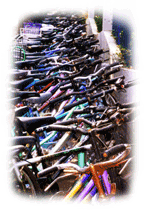
Although she is the president of a company that operates a bicycle parking lot of approximately 4,000 yards, when asked what she does she says, "I'm just the bicycle lot grandma."
http://chantforabetterlife.wordpress.com/2011/03/12/happiness-in-singapore/#comment-566
http://www.gakkaionline.net/Experiences/PubsGrandma.html
[Excerpted from the August, 2000, Living Buddhism, pp. 36-38]
Chieko Yamashita was married after WWII. Her husband failed in business and became obsessed with drinking and gambling.
Her family of four had no place to live, but were given shelter in the corner of a friend's kitchen. During the day, they would stay in a small park, with her infant child crawling around on the ground.
With help they were able to find a tiny one-room apartment; but they were still destitute.
To make dinner, she would go out with two ten-yen coins and buy sardines and spinach. She searched the streets of the outdoor market for dropped coins.
At one point, she had to leave her husband and children. The children were put into childcare. Overcome with anguish at the thought of this, she decided to gather her children and return to her husband. What followed were days of living in fear of physical abuse.
Ms. Yamashita joined the Soka Gakkai in 1965. At the time her husband was unemployed and she was supporting him by selling insurance door-to-door. Her husband also joined, but it was in name only. He would go to great lengths to keep his wife from practicing.
Each night he would beat her and demand that she quit the SGI. On one occasion he destroyed her altar with an ax, doused the wood with kerosene and set it on fire. She ran out of the house barefoot, clutching the Gohonzon to her chest. She spent the night locked outdoors chanting daimoku until dawn.
Eventually her husband found work. But he was reckless with money and they continued to live in poverty.
Throughout this time, Mrs. Yamashita scrimped and saved with the dream of one day having a house. When she had saved four million yen, she showed her savings passbook to her husband. He snatched it away. When she located it two days later, her account had a balance of zero. He had lost it all at the race track.
A senior in faith told her that she must take ultimate responsibility for her happiness. She was told "Unless you change, you will not be able to accumulate good fortune."
When she heard this, she made up her mind not to give up. She said
"The Daishonin says, 'Buddhism is like the body, and society like the shadow. When the body bends, so does the shadow' (Writings of Nichiren Daishonin, p. 1039). I determined to stop swinging between joy and sorrow because of the chaos in my life and to stop complaining about what my husband was or wasn't doing. I decided since this was my karma, I would take responsibility for overcoming it. I realized it was not about anyone else; everything depended on my life condition. I gained a profound conviction in the principle of oneness of life and environment."
| Mrs.
Yamashita exerted herself wholeheartedly in Gakkai activities. In the process,
she was unexpectedly approached about managing some land in front of the
train station. In the seventh year of her practice (1972), she was able
to open her bicycle parking lot.
More
than anything else, her attitude began to change. She came to have sympathy
for her husband. She came to view her husband as a "good friend' for enabling
her to deepen her faith.
She explains, |
 |
"It's amazing. As soon as my resentment toward my husband turned into appreciation, he suddenly lost his infatuation with gambling. And he began to pray to the Gohonzon. For the first time we became a true married couple, able to talk openly and honestly about anything. Through all the negative and positive experiences, my husband taught me about faith. I have grown into a person who can feel incredible appreciation, knowing that I owe everything to the terrible hardship I experienced."
Although she is the president of a company that operates a bicycle parking lot of approximately 4,000 yards, when asked what she does she says, "I'm just the bicycle lot grandma."
http://chantforabetterlife.wordpress.com/2011/03/12/happiness-in-singapore/#comment-566
Saturday, March 2, 2013
Protecting the environment
by Shin Won-suk
Korea http://www.sgi.org/about-us/members-stories/my-small-step.html
 Mr. Shin Won-suk cleaning the polluted river
It occurred to me that there was no need to start with something big, but there must be something I can do using my skills and background as a landscape gardener. There is a river, the Taehwa, that runs through the city of Ulsan, where I live, which is heavily polluted. I decided to somehow help restore this river.
Throughout history, the Taehwa River has been considered a lifeline for the city's residents. However, Ulsan is one of the most industrialized cities of South Korea, and because of heavy pollution from industrial waste, the Taehwa came to be known as "the river of death."
 Developing bamboo fields
In 2008, I began serving as chair of a local ecological restoration group with over 700 registered volunteers. Once a week, I engage in volunteer work such as picking up trash from the river, cleaning up hiking trails and recycling waste materials. I also take part in educational activities to raise awareness about environmental protection in the local community such as giving lectures at universities.
Seven years have passed since I began to take action and, as a result of our efforts, the beauty of the Taehwa River has been restored. Fish are once again swimming in its waters, and herons now also make the river their home.
I hope to continue encouraging my fellow SGI-Korea members and local residents to become involved in these activities.
 Volunteer members picking up trash
In Buddhism, we uphold the principle of "oneness of self and environment," meaning that life and its environment are inseparable. It is deeply rewarding to know that the small step of deciding to do something positive, and my efforts to convey to others the spirit of coexisting with nature, have led to a revival of the environment and the lives of those around me. While it's easy to be overwhelmed by problems in our communities, each of us can do something to make a difference.
[Courtesy January 2013 SGI Quarterly]
8888.henry@gmail.com
Sunday, January 13, 2013
91 years old member still active in contributing for kosen rufu
http://www.sgi.org/about-us/members-stories/the-long-road-ahead.html
The Long Road Ahead
by Atsuma Ueda
Japan
 Mr. Ueda (right) at a meeting with local business owners [©Seikyo Shimbun]
However, the new stores didn't enjoy the same success, and six months later I was on the verge of bankruptcy. I felt I could no longer go on living. All this time, my wife, Teruko, had been encouraging me to begin practicing Nichiren Buddhism. Convinced that faith had nothing to do with business, I had shown little interest.
I was intrigued, however, by the Buddhist concept of "human revolution," that a change in the inner life of a person will create a change in their circumstances, and began to read up on it. I thought, "Well, it's true that transforming myself is the basis of everything."
I started practicing Buddhism and felt full of life. I realized that my problems weren't as bad as they seemed. Around the same time, my friends began to offer their support in taking care of matters if I went bankrupt. Surprised by my optimistic attitude, they instead began to help me pull my business back together. As a result, I was able to avoid going bankrupt and business began to look up. Later, my company merged with a supermarket chain, and I was appointed company director. I went on to serve as the chief of its West Japan headquarters.
In 1983, the year before I was to retire, I received a poem of encouragement from SGI President Daisaku Ikeda during one of his visits to Hiroshima. This had a profound impact on me. It was as if he was telling me, "Your true stage awaits you!" Approaching retirement, I had been feeling as if I had reached the end of the line. However, I realized, "Yes, I am only 60 years old! There's no reason I can't go on making an active contribution until I'm 100!"
I threw myself into voluntary advisory work which I had begun doing for corporations, helping people start up businesses as well as offering advice on post-retirement life to retirees. I also dedicated myself to listening to and supporting younger colleagues.
I tell retirees, "You're still an active part of society for 30, 40 years to come. All the experiences you've gained in your busy careers are your life's treasures."
Seeing the importance of revitalizing one's community, I helped launch a local revitalization committee in my hometown of Mihara. In 1996, when I was 75 years old, I became the first general director (and currently serve as the president) of a social welfare corporation that helps people with physical and mental disabilities join the workforce.
In January 2005, when I was approaching the age of 84, I was diagnosed with prostate cancer. This was a shock, but I told myself, "There is more work to be done. I'm still in the middle of helping revitalize my local community. I mustn't die yet." I underwent treatment, and when I was tested again in October that year, all counts were back to normal.
Often, young employees come to me with their problems, telling me they want to quit. I share with them my analogy of the cup, which represents one's capacity as a human being. I tell them that they have to expand their capacity from that small cup: first to a large bowl, then to a bucket, a barrel, a pond and eventually a lake. My Buddhist practice has taught me that this is the most significant undertaking of life.
I'm 91 years old now, and the older I become, the more my horizons expand. I still have a lot of unfinished "homework" to take care of--this is what keeps my life force strong. I have a long road ahead of me. I have decided that I must win in life, no matter what. This is what keeps me vigorous.
[Courtesy October 2012 SGI Quarterly]
8888.henry@gmail.com
Saturday, November 3, 2012
Wednesday, September 19, 2012
The Building That Looks Down on Airplanes
http://www.gakkaionline.net/Experiences/WorldBuilding.html
The Building That Looks Down on Airplanes
When you don't feel like doing gongyo or daimoku, get on the green train in Tokyo that circles downtown I. and look out for the "Sunshine Building" near K--- station. This was built by someone who did not skip gongyo and daimoku for 30 years.
Once there was man who was so completely down and out that he had made up his mind to commit suicide. He was in debt to his ears, his wife was blind, and his child had problems. But before he died, he wanted to have one last meal of his favorite dish — a vegetable stew called "oden."
As he was walking around town in the evening shadows looking for a stew shop, he noticed a warm, gentle glow of lanterns coming from a place tucked in a corner. There were a number of people milling about. "Ah, a stew shop!" he delightedly mused. He walked briskly toward the light.
As he entered and made his way through the small crowd, he realized he had made a mistake. It was a lecture. When he asked a person nearby, he was told that the speaker was a Mr. Toda.
After listening, the man demanded of Mr. Toda, "If this Nam Myoho-renge-kyo is so powerful, will my financial problems be resolved?! Will my wife see?! Will my child's problems be resolved?!"
To this, Mr. Toda replied: "Don't be ridiculous! If all it did were petty things like that, I wouldn't be doing this! Your financial problems will be resolved! Your wife will be able to see! And your child's problems will be resolved! Not only that, you will become a wealthy man! You will build a building that even looks down on airplanes! Do morning and evening gongyo and chant daimoku every day."
Not because the man believed any of it, but because he was moved by the powerful conviction Mr. Toda had, he began to practice. Although it was difficult at first, he faithfully followed President Toda's instructions. He did not skip gongyo. He did morning and evening gongyo and chanted one and a half hour of daimoku every day.
Sure enough, results began to happen. His financial problems were solved. His wife was no longer blind. His child no longer had such problems. The man even became vice president of a board in his company even though he was not well-educated like most of his peers. He became wealthy. His child became active in the youth division. Things exceeded his expectations.
At the mark of practicing 30 years, he was seen standing on the top of a building, mumbling through tears. The man was standing on the top of a skyscraper that he had built. "It all became true! This building even looks down on airplanes! After 30 years ... Thank you Sensei, thank you Soka Gakkai!"
It wasn't many years later that the man passed away in his 80's, leaving a legacy of consistent practice. But before he did, he often pointed to the skyscraper and said, "This shows the power of daimoku! I am here to say it. So please, do morning and evening gongyo and chant daimoku."
So when you don't feel like doing gongyo or chanting daimoku, take a look at the "Sunshine Building." It's still there.
[Here is a picture of the City of Ikebukuro (in Tokyo) and the Sunshine Building. It is very well known and was once the tallest building in Tokyo. It has everything in it: business offices, restaurants, a department store, even an aquarium and a planetarium. The Sunshine Building was built on the site where Suginamo Prison — where Mr. Makiguichi and Mr. Toda were imprisoned — once was.]
Tuesday, April 17, 2012
Prayer
An email from Ms Sandra Liew:
Prayer
Mr. Kawai's guidance in faith, conveyed by Mr. Noro, based on President Ikeda's guidance.
We practice this faith not for mere exertion, that is, not for the sake of practice, but for change and progress and as quickly as possible.
Members may say, I'm doing many SGI activities, but so what? The real question is how much have I changed my life, my environment, and my livelihood? How much benefit have I received? There are many members who are doing lots of daimoku, but there is no change in their lives.
Something is wrong. Buddhism is not the Law of Cause and Effect in Action. It is the Law of cause and effect in ichinen (determined prayer). For example, faith is not "feeling refreshed" after prayers and activities. Faith exists for us to change our lives.
When we wish to travel somewhere, first we decide on the destination, then we plan on the action (route/ mode of transport) and then we travel and reach that destination. Faith is the same.
In faith, we must first have
1. clear targets
2. prayer
3. action
It is important to pray strongly and then take action and we will see the results without fail. It is important to determine to change. That is to pray "I want to change", and then take necessary action.
It is absolutely no use to ask the Gohonzon, "What should I do?" There will be no answer. YOU must decide what you want to accomplish, not the Gohonzon. Once we decide / determine on some goal, there may seem no solution. But that is precisely why we pray.
If it were possible, we would not need the Gohonzon. If there is a way out, then there really is no need to chant. But we pray to change the impossible to possible. Do not engage in "what shall I do..." daimoku, that is, while chanting to think of strategies / look for options in your mind.
There is absolutely no need to think of methodology, because there is no way out! We should simply pray like this "I want to accomplish this. I will accomplish this."
If, while chanting, we think that our desires are unattainable / impossible, then that is the prayer that will be reflected onto the universe. And that is exactly the answer we will get back from the gohonzon... impossible/no solution.
We must pray with 100% confidence in the Gohonzon. I believe in the Gohonzon, my prayer will definitely be answered, just as the Gosho states "no prayer to the Gohonzon will go unanswered". This is the Buddhist formula, which is 100% correct.
It is our doubts that get in the way. While chanting, we always try to find ways out of our problem. Therefore, our ichinen is not directed towards the Gohonzon, but directed elsewhere. Thus it follows, that there is no real joy in daimoku and activities.
We just keep doing what were told to do.
There was a young lady (student division) who wanted to go to USA from Japan to study. It was impossible, as she had no money etc. So she prayed, not chanted, but deeply prayed "I want to go to USA to study - I will go" One year later, she reported positive results.
There had seemed no solution, but a "bridge" was formed through her sincere daimoku. This is the Mystic Law. It is beyond our understanding, which is why it is called Mystic. So there is no need to think, just trust and pray...
There was a WD who came for guidance. Her husband had terminal cancer and doctors said he would not live longer than 3 months. Her question was "can he be cured?" The answer was "I don't know".
The leader went on to say that President Toda's guidance was that when we determine that the only one thing we can trust is the gohonzon, then the body begins to recover from sickness.
This means to cure ones own illness by oneself, through faith. The human body is capable of producing 700 types of medicines. But when our life force is weak, then nothing is produced. When our life philosophy is polluted by slander, and impurities then our life cannot produce its healing power.
Buddhism is great. Our life is great! It is supreme. It is Divine. It is the life of the Buddha. So through faith we can always manifest this supreme state of the Buddha, this power of the Gohonzon.
People call Buddhism great, but actually it teaches us that our own lives are great. With determination, great life force and wisdom can be manifested from our lives and bodies to overcome sickness which is one's negative karma -the source of which is slander.
So the real question is not whether the illness is curable, rather, the question is whether i can determine it is curable. The woman told her husband about this guidance and together both corrected their ichinen and prayed and he was cured.
A Woman's Division leader in Japan could not walk due to pain in her legs caused by rheumatism. She was asked "do you think that your disease can be cured?"
She replied "No!"
"So then that is your desire. Your state of mind and that is why the answer from the Gohonzon is - - no cure!" replied the senior leader. The leader continued by saying that if the medical doctor has given up, if he says there is no cure for your condition, then that is the time to summon up your determination to change the impossible to possible.
The very next day, the woman called the leader to report that when she determined, the pain disappeared from her legs and 2 weeks later she was completely cured. Her suffering had been caused by her thinking that it was impossible to be cured, that she would have to live with this life condition.
But the moment she determined (ichinen) to overcome through faith in the gohonzon, the power of the mystic law was manifested through her life.
There are 3 kinds of directions:
1. Forward "Gear". Forward Gear practice consists of: having a clear and specified target and determination to accomplish it through prayer and action, for example: I want a white cat. She must be of Persian species, 3 yrs old, with blue eyes, female.
And I want her in 2 weeks. I will get it. In other words, doing a lot of activities and daimoku with no targets and clear goals is no use, as it will not produce any changes in your life.
2. Neutral "Gear" Neutral Gear Practice is chanting out of duty, with no joy. A habitual practice. E.g.: I am a leader, I have responsibilities, so I'm doing activities. But there is no effect. Its like the car analogy... the engine is full and ready to go... but nothing happens.
3. Reverse "Gear" Reverse Gear Practice is when the more activities and daimoku one is doing, one is still going backwards, rather than forward in one's life. In other words, one may be making a lot of seemingly good causes, but one is also complaining. There is slander and grudges against others. Or one might be Complaining about ones' own situation on not seeing immediate results. This is dangerous practice.
Just like in automatic transmission car, there is very little difference between Forward and Reverse Gears, from outward appearance it is difficult to tell where one's ichinen is. But one's life will ultimately clearly manifest it.
Slander
Even if you commit slander without realizing it, it is still slander. One should never criticize leaders. Right or wrong, one should not complain at all. Instead, one can chant for them to grow and one will benefit from that too. Similarly, never do "onshitsu" in your family.
That is do not complain, criticize or carry a negative feeling towards husband /wife, children or parents. This is your karma. You chose your spouse / partner / children.
Chant for their growth.
Further, do not depend / rely on others. Do not complain that they don't do this or that. Criticism will bring no benefit. But it will certainly bring negative effects.
In conclusion
We must eradicate the following types of prayer:
1. Out of habit or ritual (that is without any target or determination)
2. Out of delusion (that is while chanting, trying to find solutions to your problems)
3. Out of disbelief (that is thinking that this is impossible and will not happen / change)
Instead, pray with your entire heart, your entire being that I am going to build a bridge towards my happiness and those of others by myself, by using the Supreme wisdom of Nam Myoho Renge Kyo.
One needs to have the experience of benefits / breakthroughs, so as to encourage others. "I have so many benefits through this practice... what about you?" Especially, senior members must receive many benefits. Buddhism is reason. Otherwise what is the use of practicing this faith? If they don't witness changes/ benefits then their faith has become habitual.
Experiences
There was a Men's Division Chapter Chief in Japan, which had a small trading company, which was almost bankrupt. The sales had dropped by half. At that time he prayed deeply that the sales should climb to $3 million. And it became so. The next year, his target was $5 million and the year later $7million. So it is important to determine first, then chant.
An owner of a barber-shop reported drop of sales due to lack of customers. He was advised to determine and pray concretely and in specific detail e.g. exact number of customers for haircuts, for blow dry etc. - detailed prayer, with a deadline.
One member prayed to sell his car. He did, but with no profit at all. Because he did not pray for it.
One woman had severe economic / financial problems. She prayed 3 hours daily in the morning - I want this amount of benefit today. I need it. And she received it.
We need to experience benefits through faith and prayer to show power of Gohonzon and encourage others. President Toda and President Ikeda said there are 10 reasons why no change or benefits occur in senior leaders' lives, even though they have been practicing for a long time.
1. Unclear determination
2. No concrete targets in faith
3. Doing regular Gongyo but no concrete prayer
4. Passive gongyo and activities from a sense of obligation
5. A complaining and begrudging attitude about faith
6. Seeking spirit for senior leaders/ guidance has become weaker
7. Not working hard in office or home
8. Depressed because of various sufferings in life
9. Weak of sense of mission for Kosen Rufu
10. Sense of responsibility as leader is weaker
Even if one of the above is missing, then faith has become habitual and there is no benefit. We must have dreams, which lead to hope and finally become reality when we chant! Therefore, we must have big dreams!
Experience
The President of a Fisheries Co was very concerned about the drop in catch of fish as it was affecting his sales, so he went for guidance. The leader asked him
"You say that you can't get lots of salmon fish. Does this mean that there is no salmon or are you unable to catch them?"
"I can't get any," he replied.
"Why can't you call them to your net? Did you pray like that?" The leader encouraged.
"No I didn't".
"There is no natural boundary in the ocean. So why don't you pray like that?"
The leader encouraged. So he did. His catch went up from 20 fish to 300 in one day. His company went from deficit to surplus. This is no miracle. This is the Law. This is reason.
What is amazing is when you don't get benefits even though you do chant.
Subscribe to:
Posts (Atom)